What are AR and VR in E-Learning? How Did AR and VR Accelerate Innovation?
E-learning is undoubtedly a sector whose popularity has increased in recent years. As a concept, it emerged from the idea of distance education and was developed to make the exchange of information much easier by using communication tools such as the internet.
In pre-internet distance education, educational materials were mailed, and work such as projects or assignments was sent back to the instructor. The emergence of e-mails made this process much more manageable. Later, as efficient video conferencing tools were developed, e-learning also developed and found more and more space for itself in the education community.
The latest developments in e-learning have allowed AR and VR to be added to the list of educational tools that can enhance online learning environments. So how can AR and VR be used in an educational context? What is the difference between AR and VR, and what impact can they have on e-learning?What is E-Learning?
E-learning is the general name given to education conducted electronically, mostly through the internet or internet-connected tools. Although it is already a large sector, it is expected to continue to grow and reach a value of $457.8 billion by 2026.
E-learning can consist of many different levels and content. This content can take the form of live webinars, pre-recorded lectures, videos, traditional written materials, games, and quizzes. E-learning can be used for many things, from health and safety to sales strategies, depending on your company's needs.
What is the Difference Between AR and VR?
Now let's get to the more technical part. Many people incorrectly use these two terms interchangeably. AR and VR are based on similar but different technologies, are used for different things, and have different market goals.
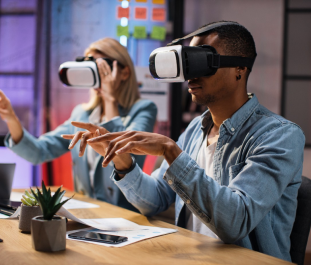
VR (virtual reality) uses a headset to block external sensory inputs, so the user experiences a multidimensional and immersive experience in the virtual reality presented. For example, if you are planning a virtual call center, you can set up a VR training module if you want to train people in virtual customer service.
In AR (augmented reality) technology, digital elements are added to the world that the user sees with their own eyes with the help of everyday devices (phone, computer, tablet, etc.). Therefore, the main difference between the two is that one (VR) creates a completely virtual world, while the other (AR) combines the real world with digital elements.
How are AR and VR Used in E-Learning?
Both technologies have many practical uses for education beyond the examples given earlier. There is no doubt that both technologies are among the most exciting innovations in the education technology sector. Thanks to their flexibility, they can be used as learning tools in everything from medicine to art and humanities, retail, and technology sectors. The widespread use of AR and VR in education offers new, exciting opportunities for educators, educational institutions, and users. Until recently, the visualization of educational material has mostly been in 2D. As an example, you can think of the illustrations in a science textbook. AR and VR offer new opportunities to explore these illustrations in more detail.
Applied Use Cases of AR and VR
1. Enhanced Simulations
Before AR and VR were used, simulations were often presented on laptops, desktops, or mobile devices/tablets. These methods meant that people could easily be distracted from what they were trying to learn. With AR and VR, these distractions are eliminated by using dedicated headsets, which allows users to focus better.
2. Improved Gamification
Gamification is a popular approach found in many trainings. It encourages friendly competition while making learning more fun. AR and VR can take this gamification to the next level by offering tangible rewards and competitive leaderboards. It is not directly related to e-learning, but the Pokemon Go game is an excellent example of the use of AR for gamification.
3. Customizing E-Learning Paths
You can visualize all kinds of training using AR and VR, so you can ensure that users learn better and progress. You can also use these technologies to provide customized training that focuses on where each user is stuck, allowing them to reinforce the topics.
4. Providing Visual Feedback
Feedback on written exams is usually either written or verbal via video conference. When these exams are conducted in AR or VR, in addition to being recordable, the user can visually see what they are doing wrong.