Most leadership training ends with a quiz about leadership. A simulation ends with something more useful: a record of what the participant actually decided when an employee sat in front of them with a real problem. This article explains how the browser-based leadership simulation we built for corporate training turns those decisions into measurement — what is scored, how, and where the limits are.
The Question Behind the Simulation
The design started from one question: can we see how a manager handles one-to-one conversations without watching them in real meetings? Real conversations are private, rare and impossible to repeat. A simulation can put every participant in front of the same people with the same problems, record each choice and show the consequences — including the ones that only appear weeks later.
How a Session Works
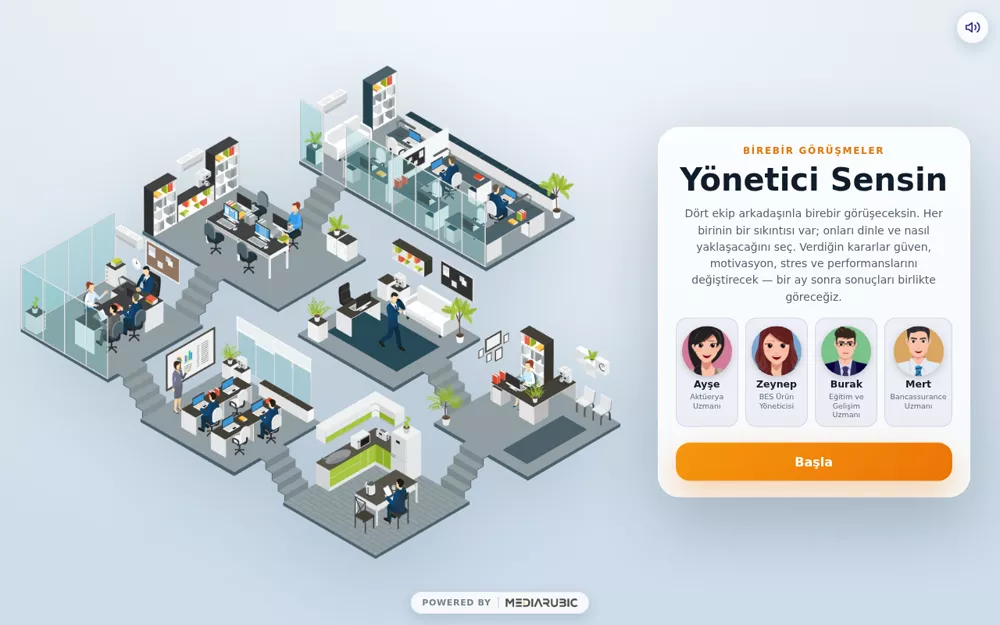
The participant plays a manager with a team of four. Each team member has a role, a personality in their dialogue and their own set of issues.
- Round 1 — first conversations. Each employee raises five topics: workload before a deadline, criticism of their work, friction with another team, career direction and similar everyday situations. For each topic the employee speaks first, and the manager chooses one of three responses.
- One month later. A short interlude shows how each employee is doing after a month of the manager's approach: better, unchanged or worse.
- Round 2 — follow-up conversations. The same people come back, but what they say depends on round one. If a workload problem was handled well, the employee returns with a new opportunity, such as being asked to mentor a newcomer. If it was handled badly, the same problem is back, and bigger.
That second round is the core of the design. Leadership decisions rarely fail in the moment; they fail a month later. Making the follow-up depend on earlier choices is what turns a quiz into a simulation.
Four Indicators, Not One Score
Every employee carries four indicators on a 0–100 scale: trust, motivation, stress and performance. They start at 50, 50, 45 and 50. Each response changes all four at once, because real management choices rarely move just one thing.
Take an employee who says the workload has become unsustainable before a reporting deadline:
- "Let's agree on priorities together and move the non-critical analysis to next period" — trust +12, motivation +9, stress −12, performance +7.
- "Deadline periods are always busy, you'll need to hold on a bit longer" — trust −10, motivation −9, stress +12, performance −5.
- "Let's get through this period and look at it afterwards" — trust −4, motivation −5, stress +7, performance −2.
Separating the indicators matters. A response can lower stress while quietly hurting performance, or raise short-term output while draining trust. A single score would hide exactly the trade-offs a leadership programme wants to discuss.
Why Every Answer Has a Hidden Tone
Each response is also tagged with a tone the participant never sees: coaching, supportive or balanced on one side; harsh, cold, dismissive or judging on another; passive, avoidant or postponing on a third. The tags do two jobs. They classify every decision as strong, medium or weak, and they let the final report explain why a decision was weak, not just that it was.
The Comfortable Answer Trap
The most instructive options are the ones that feel kind. When an employee is upset about criticism of their work, a manager can say "Don't worry about it, your work was fine." In the simulation that answer nudges trust and motivation up slightly — and lowers performance, because the real problem was never addressed.
These options exist on purpose. If the right answer is always the warmest-sounding one, participants learn to pick by tone and the simulation measures nothing. Warm but avoidant responses reveal a genuine leadership habit: protecting the relationship at the expense of the person's development.
What the Final Report Shows
- A leadership grade from A to E, based on the quality of decisions: A from 85 points, B from 70, C from 55, D from 40, E below.
- The four indicators with their direction for the whole team — up, down or flat, where lower stress counts as an improvement.
- The weak decisions, grouped into patterns: a harsh or critical tone, a pressuring approach, or a dismissive, postponing approach. Each pattern comes with a concrete development tip, such as "listen and build a solution together before criticising".
The model is deterministic: the same choices always produce the same result. That is a deliberate choice for training. Two participants who made the same decisions get the same outcome, results can be compared across a group, and a facilitator can point to the exact decision that changed a team member's path.
Running It as a Workshop
The simulation works for individuals, but it was designed for groups. A facilitator screen shows a QR code; participants join from their own phones, play through their conversations, and each completed session appears in the facilitator's report list in real time. In a kiosk set-up the game returns to the start after each player, so a whole team can take turns on one screen.
The debrief is where the learning is anchored. Because every participant faced the same four people, the group can compare: who chose to set priorities together, who told the employee to hold on, and what each choice did a month later.
What a Simulation Can and Cannot Measure
It is worth being precise. A leadership simulation measures choices in realistic, scripted situations. It does not observe how someone speaks, listens or reads a room, and it is not a personality test. Its value is consistency: everyone faces the same situations, consequences are visible, and patterns in a person's decisions become discussable.
Its validity depends on the scenarios. The situations in ours were written around the actual roles of the team members being simulated, so participants recognise the conversations from their own work. A generic scenario set would be easier to build and much easier to dismiss.
Building One for Your Organisation
- Define the behaviours the programme wants to change, and what a strong response looks like.
- Write situations from real roles, with three plausible responses each, including one that sounds kind but avoids the problem.
- Assign effects and tones to every response and check that no answer can be found by tone or length alone.
- Design the follow-up round so that consequences, not just scores, carry the lesson.
- Pilot with a small group and adjust effects that feel unrealistic before the full rollout.
More about how we design and deliver training simulations and multiplayer team games is on our serious games & training simulations page. For the broader idea of learning by deciding, see gamified leadership simulations.
Frequently Asked Questions
Is a leadership simulation a personality test?
No. It records decisions in scripted management situations and shows their consequences. It can reveal patterns such as avoiding difficult conversations, but it does not measure personality traits.
Why use several indicators instead of one score?
Because management decisions involve trade-offs. A response can reduce stress while hurting performance, or raise output while damaging trust. Separate indicators make those trade-offs visible and discussable.
Can participants simply guess the right answers?
Not reliably. Some of the warmest-sounding responses avoid the real problem and lead to worse outcomes a month later, so choosing by tone does not work.
Can the simulation be run with a whole team at once?
Yes. Participants join from their phones through a QR code, and the facilitator sees each completed session in a live report list before the group debrief.